Customer Journey Map: Learn How to Create, Benefits, Types of Customer Journey Mapping

Customer Journey Map: A Strategic Blueprint for Enhancing Your Customer Journey
In the ever-evolving landscape of customer engagement, understanding how your customers interact with your brand is crucial. A customer journey map serves as a strategic blueprint that illustrates the path customers take, from their initial awareness of your product or service to their ongoing relationship with your brand. By leveraging a well-crafted customer journey map, businesses can gain insights into customer behaviors, preferences, and pain points, ultimately enhancing the customer experience and fostering loyalty.
What is a customer journey?
A customer journey encompasses the full range of interactions and experiences a customer has with a brand throughout their lifecycle. This journey begins with initial awareness, where potential customers first encounter your brand, and continues through various stages such as consideration, purchase, retention, and advocacy. Each touchpoint within this journey is an opportunity for businesses to connect with customers, provide value, and address their needs.
Understanding the nuances of the customer journey is essential for creating effective marketing strategies. It allows businesses to tailor their messaging and offerings to resonate with customers at every stage, ensuring that they receive the right information and support when they need it most. As the customer journey evolves, businesses must stay attuned to shifts in customer expectations and behaviors to maintain relevance and competitiveness in the market.
Customer journey vs. buyer journey
While the terms “customer journey” and “buyer journey” are often used interchangeably, they represent distinct concepts that are important to understand. The customer journey refers to the overall experience a customer has with a brand, encompassing all interactions, regardless of whether they result in a purchase. In contrast, the buyer journey specifically focuses on the process a potential customer undergoes leading up to their purchase decision.
The buyer journey typically consists of three key stages: awareness, consideration, and decision. During the awareness stage, buyers recognize a problem or need; in the consideration stage, they explore potential solutions and evaluate their options; and finally, in the decision stage, they make a purchasing choice. Recognizing the difference between these journeys allows businesses to tailor their approaches—focusing on brand engagement for the customer journey and persuasive communication for the buyer journey.
What is a customer journey map?
A customer journey map is a visual representation that outlines the various stages and touchpoints a customer encounters throughout their journey with a brand. It illustrates the customer’s experiences, emotions, and interactions, providing valuable insights into their perceptions and expectations. By creating a customer journey map, businesses can identify areas of friction and opportunities for enhancement, making it an essential tool for optimizing customer experience.
The process of mapping the customer journey requires a deep understanding of customer behaviors and motivations. It involves gathering data through customer feedback, surveys, and analytics to create a comprehensive view of the customer experience. This mapping process allows organizations to visualize the complete journey, helping them prioritize improvements and ensure that every interaction aligns with their customers’ needs and expectations.
What is customer journey mapping?
Customer journey mapping refers to the process of creating visual representations of the customer’s journey. This methodology involves gathering insights from various sources, including customer feedback, surveys, and analytics, to develop a thorough understanding of the customer experience. By mapping the journey, businesses can identify pain points, gaps, and opportunities for improvement.
The value of customer journey mapping lies in its ability to provide a holistic view of the customer experience. It allows businesses to visualize not only the steps customers take but also their emotions and motivations at each stage. This understanding enables organizations to create more personalized and impactful experiences that resonate with customers, fostering loyalty and driving satisfaction.
What is customer experience journey mapping?
Customer experience journey mapping focuses specifically on the overall experience a customer has with a brand across all touchpoints. Unlike customer journey mapping, which may emphasize specific interactions or transactions, customer experience journey mapping takes a broader approach by considering every aspect of the customer’s relationship with the brand. This type of mapping highlights emotional aspects and pinpoints pain points, enabling organizations to enhance customer satisfaction effectively.
By understanding the emotional drivers behind customer behavior, businesses can craft strategies that not only meet functional needs but also create positive emotional connections. This approach is essential for fostering loyalty, as customers are more likely to return to a brand that resonates with them on an emotional level.
What is UX journey mapping?
UX journey mapping (user experience journey mapping) narrows the focus to the usability and experience of a specific product or service. This approach helps businesses identify how customers interact with their offerings, allowing them to optimize the user experience based on feedback and behavior analysis. UX journey mapping is particularly important in digital environments, where user interactions can significantly impact customer satisfaction.
By analyzing the user experience, businesses can make data-driven decisions to enhance usability, navigation, and improve overall satisfaction. This type of mapping is critical for digital products, websites, and applications, ensuring that customers can easily access the information and functionalities they need.
Why is customer journey mapping important?
Mapping the customer journey is crucial for several reasons. First, it helps businesses identify pain points within the customer experience. By visualizing the journey, organizations can pinpoint areas where customers encounter challenges or frustrations, enabling them to address these issues proactively.
Customer journey mapping enhances the overall customer experience. By understanding the journey, businesses can make targeted improvements that create a more enjoyable experience. This leads to increased customer satisfaction, loyalty, and advocacy.
Finally, insights gained from customer journey mapping inform strategic decision-making. The mapping process allows businesses to understand how customers engage with their brand, which can guide marketing, sales, and customer service strategies. By aligning these efforts with customer needs, organizations can optimize their approaches and achieve better outcomes.
Benefits of customer journey mapping
Some of the most important benefits of customer journey mapping are:
- Improved customer retention: By identifying and addressing pain points, businesses can foster loyalty and retain customers more effectively. A well-mapped customer journey allows organizations to create strategies that enhance satisfaction and keep customers coming back.
- Improved sales processes: A better understanding of customer needs can lead to more effective sales strategies, driving conversions. By tailoring messaging and offers to align with customer motivations, businesses can improve their chances of closing sales.
- Alignment across teams: Journey mapping encourages collaboration across departments, ensuring a unified approach to customer experience. When marketing, sales, and customer service teams have a shared understanding of the customer journey, they can work together more effectively to meet customer needs.
- Enhanced personalization: By mapping the customer’s journey, businesses can identify opportunities for personalization, creating more relevant and meaningful interactions. Personalization leads to higher engagement and satisfaction, ultimately driving loyalty.
- Data-driven decisions: Customer journey mapping relies on data and insights, enabling businesses to make informed decisions based on real customer behavior. This data-driven approach helps organizations prioritize initiatives that will have the greatest impact on the customer experience.
What is customer journey analytics?
Customer journey analytics involves analyzing data collected at various touchpoints to understand customer behavior better. This analytics process helps businesses identify trends, preferences, and pain points, providing actionable insights for optimizing the customer experience.
What data is necessary for customer journey mapping?
To create an effective customer journey map, businesses should gather data from various sources, including:
- Customer feedback and surveys: Gathering insights directly from customers through surveys, interviews, and feedback forms provides invaluable information about their experiences and expectations.
- Website and app analytics: Analyzing user behavior on websites and mobile applications helps organizations understand how customers interact with digital touchpoints, identifying areas for improvement.
- Sales data: Reviewing sales data can reveal trends in purchasing behavior, helping businesses understand what drives conversions and which products or services resonate with customers.
- Customer service interactions: Analyzing interactions with customer service teams can highlight common issues and areas for improvement, ensuring that businesses address customer concerns effectively.
- Social media insights: Monitoring social media engagement allows organizations to gauge customer sentiment and identify trends or feedback that may impact the customer journey.
How to create a customer journey map
Creating a customer journey map involves several stages that reflect the different phases customers go through. Each stage presents unique opportunities and challenges, making it essential for businesses to understand how to guide customers effectively through their journeys.
Customer journey stages
Awareness stage (discovery stage)
This stage marks the beginning of the customer journey. Customers become aware of a brand or product through marketing efforts, social media, or word-of-mouth. Understanding how customers first encounter your brand is crucial for optimizing marketing strategies and ensuring that messaging resonates with potential customers.
Interest stage (engagement stage)
At this stage, customers express interest and seek more information about the product or service. They may visit your website, read reviews, or engage with your content on social media. Businesses should focus on providing valuable information and engaging content that captures customer attention and encourages further exploration.
Consideration stage (evaluation stage)
Customers weigh their options and compare different solutions, including the pros and cons of each. In this phase, providing detailed product information, testimonials, and comparisons can help customers make informed decisions. Businesses should emphasize how their offerings address customer needs and set them apart from competitors.
Purchase stage (decision stage)
This is the moment when customers make a purchase decision and complete the transaction. Ensuring a straightforward purchasing process is crucial for minimizing friction and maximizing conversions. Businesses should also consider post-purchase follow-ups to reinforce customer satisfaction.
Retention stage
After the purchase, the focus shifts to maintaining customer satisfaction and encouraging repeat business. Effective communication, personalized follow-ups, and loyalty programs can help keep customers engaged and satisfied, ultimately leading to long-term relationships.
Advocacy stage
In the advocacy stage, satisfied customers become brand advocates, sharing their positive experiences and recommending the brand to others. This stage is crucial for generating organic referrals and building brand loyalty. Encouraging customers to leave reviews, share their experiences on social media, and participate in referral programs can help amplify the brand’s reach and influence. It’s essential to nurture these advocates by maintaining ongoing communication and offering exclusive rewards or incentives for their loyalty.
What’s included in a customer journey map?
A comprehensive customer journey map includes several key elements that provide a holistic view of the customer experience:
The buying process
This outlines the steps customers take from awareness to purchase and beyond. Mapping this process helps businesses understand how customers interact with various touchpoints and identify opportunities for improvement.
Emotions
Capturing customer emotions at each stage of the journey is critical. Understanding how customers feel during their interactions can provide insights into pain points and moments of delight, allowing businesses to create more positive experiences.
User actions
Documenting the actions customers take throughout their journey helps organizations visualize engagement patterns and identify where customers may drop off or experience frustration.
User research
Incorporating findings from user research, such as surveys or interviews, provides valuable context for understanding customer motivations and expectations.
Solutions
Highlighting potential solutions to address identified pain points allows businesses to strategize and implement changes that enhance the customer experience.
What are the steps to create a customer journey map?
Creating an effective customer journey map involves several steps:
- Define the scope: Determine the specific customer journey you want to map, focusing on a particular product, service, or audience segment.
- Gather data: Collect qualitative and quantitative data from various sources, including customer feedback, analytics, and market research, to gain a comprehensive understanding of the customer experience.
- Identify customer personas: Create detailed customer personas that represent different segments of your target audience. This helps ensure that the map reflects the diverse experiences of all customer types.
- Outline the journey stages: Break down the customer journey into distinct stages, highlighting key touchpoints and interactions that occur at each phase.
- Map emotions and actions: At each stage, document customer emotions, actions, and potential pain points. This step is crucial for identifying areas of improvement.
- Analyze and identify opportunities: Review the completed map to identify trends, gaps, and opportunities for enhancing the customer experience. Prioritize initiatives based on potential impact and feasibility.
- Implement changes: Develop and implement strategies to address identified pain points and enhance the overall customer experience.
- Monitor and update: Continuously monitor customer feedback and journey analytics to ensure that the map remains relevant and reflects changes in customer behavior. Regularly updating the map helps businesses stay agile and responsive to evolving customer needs.
Types of customer journey maps
Different types of customer journey maps cater to various aspects of the customer experience. Understanding these types can help businesses choose the right approach for their mapping efforts.
Current state
The current state journey map reflects the existing customer experience. It identifies touchpoints, pain points, and areas for improvement as they currently exist, providing a baseline for enhancement efforts. We have found a great template that guides you through each step of the process.
Day in the life
The day in the life map focuses on a customer’s daily routine, illustrating how the product or service fits into their life. This perspective allows businesses to understand contextual factors that influence customer behavior and decision-making.
Future state
The future state map envisions an ideal customer experience. This type of mapping helps organizations define goals and aspirations for customer engagement, allowing them to strategize and plan initiatives that align with their vision.
Blueprint
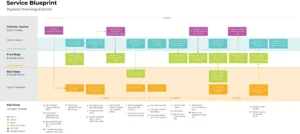
The blueprint journey map combines elements of the current and future state maps, illustrating both the existing experience and the desired improvements. This comprehensive approach helps businesses visualize the transformation they seek to achieve. Here’s an example of a blueprint journey map:
Source: Outwitly
Other types of customer journey maps
In addition to the primary types mentioned, other journey mapping approaches include:
- Service blueprinting: This type focuses on both the front-stage (customer-facing) and back-stage (internal processes) interactions, providing a holistic view of the service experience.
- Experience map: An experience map captures a broader view of customer experiences, including emotional and contextual factors, to inform overall strategy.
- Empathy map: This approach centers on understanding customer emotions, thoughts, and behaviors, allowing businesses to empathize with their audience and create more meaningful experiences.
Customer journey map examples
Visualizing customer journey maps can significantly enhance understanding and provide practical insights. Here are some examples to illustrate how different businesses approach journey mapping:
Maximizer’s role in the customer journey map
Maximizer equips businesses with tools and insights to build and refine their customer journey maps, helping them understand and enhance each stage of their customers’ experience. Through structured data and analytical capabilities, Maximizer supports organizations in identifying key touchpoints, customer emotions, and areas for improvement, empowering businesses to create more engaging and impactful customer journeys.
B2B customer journey map example
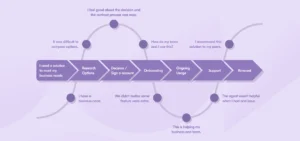
In a B2B customer journey map, the stages often include awareness through networking, consideration through product demos, purchase via contract negotiations, and retention through ongoing support. This map focuses on the longer decision-making process typical in B2B transactions, emphasizing relationship building and trust. Here is a great example by Touchpoint.
Source: Touchpoint
B2C customer journey map example
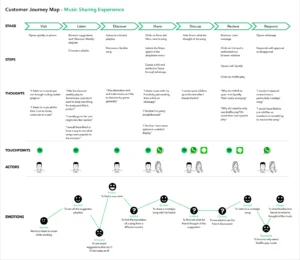
A B2C customer journey map may highlight stages such as discovery through social media, engagement via email marketing, purchase on an eCommerce site, and advocacy through customer reviews. This type of mapping emphasizes fast-paced interactions and the emotional drivers that influence consumer choices. Spotify has a very in-depth map that covers the majority of considerations you need to make when crafting your customer journey map.
Source: Woopra
E-commerce customer journey map example
For an e-commerce customer journey map, stages may include awareness through targeted ads, interest through product recommendations, consideration through user-generated content, purchase through an intuitive checkout process, and retention through personalized follow-ups. This map emphasizes the importance of smooth online experiences and post-purchase engagement. Here’s a great example by Freshworks that covers everything you need to know.
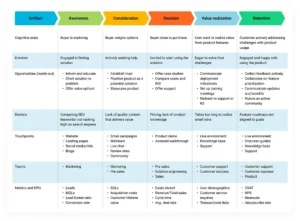
Image source: Freshworks.com
Retail customer journey map example
In a retail customer journey map, stages may involve in-store awareness through window displays, interest through product sampling, consideration through sales consultations, purchase at the checkout, and retention through loyalty programs. This type of mapping highlights the critical role of physical interactions in customer experiences. Amazon, while primarily an online retailer, has perfected this journey, here’s an example of a customer journey map from Amazon that you can take and apply to both physical and virtual storefronts.
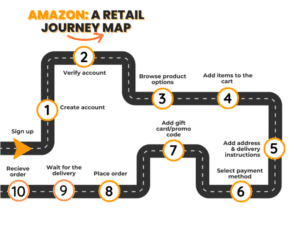
Source: Surveysparrow
Tools for mapping the customer journey
Several tools can facilitate the process of creating a customer journey map, enabling businesses to visualize and analyze customer experiences effectively. Some popular tools include:
- Customer journey mapping software: Platforms like Smaply, Lucidchart, and Miro provide templates and collaborative features for creating visual maps.
- Analytics tools: Google Analytics and similar platforms offer insights into customer behavior, helping businesses identify touchpoints and interactions.
- Survey tools: Tools like SurveyMonkey or Typeform enable businesses to gather customer feedback and insights to inform mapping efforts.
- CRM systems: Customer Relationship Management (CRM) software, such as Maximizer, can help organizations collect and analyze customer data, providing valuable insights for journey mapping.
Optimizing the customer experience with your customer journey map
Creating a customer journey map is only the first step; optimizing the customer experience based on the insights gained is essential for achieving meaningful results.
Strategic improvements at each stage
At each stage of the customer journey, businesses should focus on strategic improvements that enhance the overall experience. For example:
- Awareness stage: Improve marketing outreach through targeted campaigns and optimized content that speaks directly to customer needs.
- Interest stage: Offer valuable resources, such as educational content or interactive tools, that engage customers and build trust.
- Consideration stage: Provide in-depth product information, customer testimonials, and comparison guides to help customers make informed decisions.
- Purchase stage: Enhance the checkout process and offer multiple payment options to reduce friction during the purchase.
- Retention stage: Implement personalized follow-up communications, loyalty programs, and exclusive offers to keep customers engaged.
- Advocacy stage: Encourage satisfied customers to share their experiences and reward them for referrals to amplify brand visibility.
Technological enhancements at each stage
Integrating technology can significantly enhance the customer journey at each stage:
- Awareness stage: Utilize AI-driven marketing tools to deliver personalized ads and content based on user behavior and preferences.
- Interest stage: Implement chatbots or live chat features to provide instant assistance and answer customer inquiries in real time.
- Consideration stage: Leverage CRM systems to track customer interactions and preferences, enabling tailored communication and follow-ups.
- Purchase stage: Use data analytics to optimize inventory and pricing strategies, ensuring that customers receive competitive offers.
- Retention stage: Implement automated email marketing campaigns to nurture customer relationships and encourage repeat purchases.
- Advocacy stage: Utilize social media platforms and review sites to promote positive customer experiences and foster community engagement.
Avoiding common mistakes in customer journey maps
While creating a customer journey map can provide valuable insights, it’s essential to avoid common pitfalls that can undermine its effectiveness:
- Overlooking customer emotions: Failing to capture customer emotions can lead to a superficial understanding of the journey. It’s crucial to document how customers feel at each stage to identify pain points and opportunities for improvement.
- Neglecting to update the map: Customer behaviors and preferences change over time, so it’s vital to regularly review and update the journey map to ensure it reflects current realities.
- Focusing only on touchpoints: A narrow focus on touchpoints without considering the broader context can result in missed insights. It’s important to look at the entire experience, including emotional drivers and external factors.
- Ignoring the data: Basing the journey map on assumptions rather than real customer data can lead to misguided strategies. Always prioritize insights from customer feedback and analytics.
- Involving only one department: Customer journey mapping should be a collaborative effort involving multiple departments, including marketing, sales, and customer service. Engaging various stakeholders ensures a holistic view of the customer experience.
Subscribe to our Newsletter
Related Articles